There are 2 ways to choose from:Option 1 (recommended): Enable Model discovery:
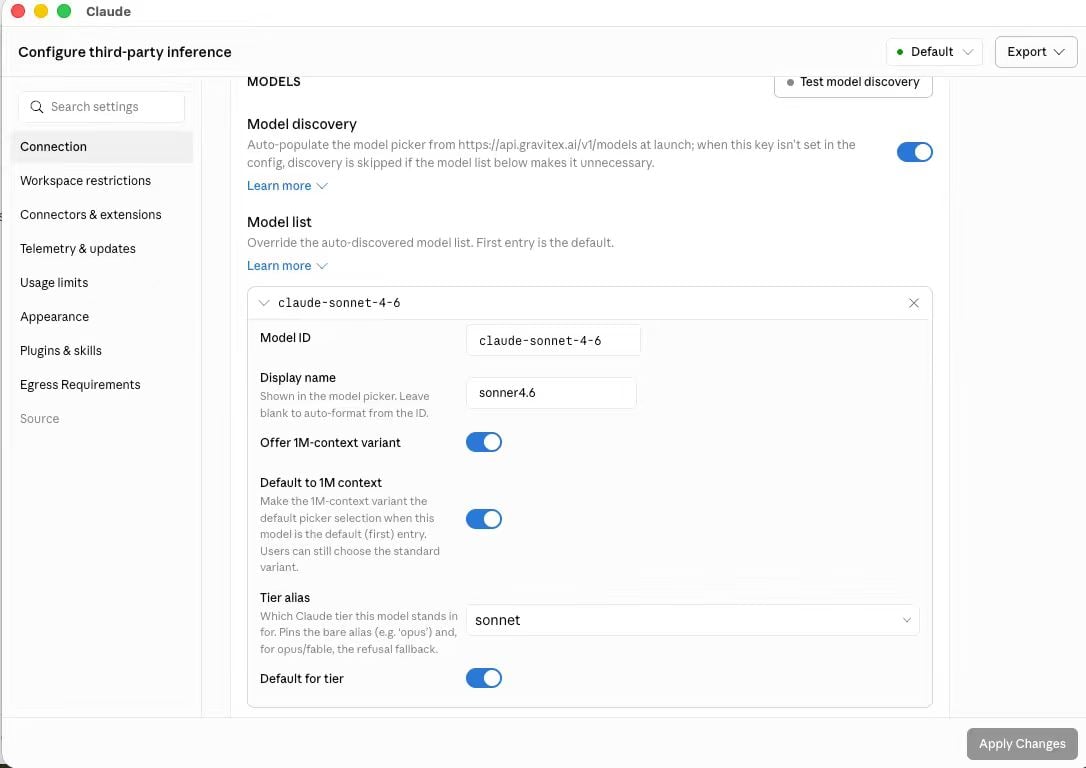
Check “Auto-populate the model picker from {base URL}/v1/models at launch”.
Click Test model discovery to confirm the supported model list can be fetched.
The model dropdown will automatically show only supported models, avoiding incorrect model names.
Option 2: Manual specification. Click + Add in the Model list and fill in:
Field
Description
Model ID
Must match the model ID supported by GravitexAI (with version number), e.g., claude-haiku-4-5-20251001, claude-fable-5.
Display name
The name shown in the model dropdown, customizable, e.g., Claude Opus 4.5.
Offer 1M-context variant
Enable if the model supports 1M context; keep disabled for regular models.
Tier alias
Required. Select the corresponding Claude tier for this model, e.g., opus, sonnet, haiku, fable. Claude Desktop uses these tier aliases to dispatch lightweight/powerful tasks and fallback.
Why is Tier alias important?Claude Desktop internally uses opus / sonnet / haiku / fable tier aliases to allocate different types of calls (e.g., lightweight summary tasks may use haiku, complex reasoning uses opus). If you set claude-opus-4-8’s Tier alias to opus, the client knows to treat it as the Opus tier; leaving it empty or selecting incorrectly will cause an “Invalid: Model list” error.📌 The first item in the Model list is the default model. It’s recommended to place your most frequently used model (e.g., Sonnet) at the top.
Common error: “Invalid: Model list” at the bottomUsually caused by one of the following:
Tier alias not selected;
Model ID duplicates an existing entry;
Model ID format not accepted by the client (contains spaces, special characters, etc.).
After fixing, click Save Changes first, then Apply Changes.
API Key is equivalent to a password — do not include it in public documents, screenshots, or code repositories.
Exported configuration files (.mobileconfig / .reg / .json) may contain plaintext keys. Store them only briefly on trusted devices and delete after use.
If your Key has been exposed in chats, screenshots, or logs, revoke it immediately and regenerate.